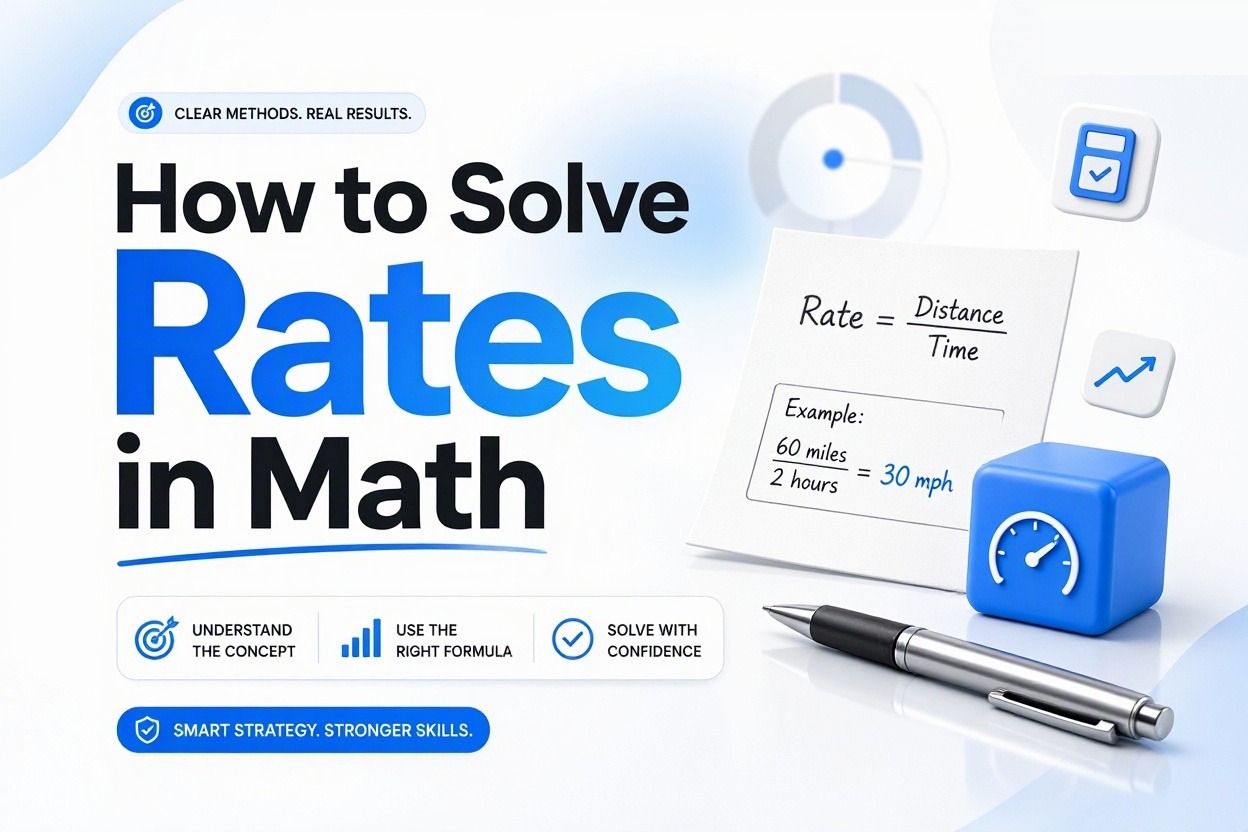
Rates in math compare two quantities with different units. To solve them, write the relationship as a fraction, keep units attached, reduce when appropriate, and use multiplication or division to find an unknown value. For example, if a car travels 180 miles in 3 hours, its rate is 180 ÷ 3 = 60 miles per hour.
Rates appear in school problems, shopping comparisons, recipes, travel planning, wages, speed, and science. The key is identifying what is being measured per one unit. A rate may describe distance per time, cost per item, words per minute, or gallons per mile.
Most rate problems become manageable when you organize the known information before calculating. Write each quantity with its unit, choose the operation that matches the situation, then check whether the final unit makes sense. A result of 60 miles per hour is meaningful; a result of 60 hours per mile usually signals an inverted calculation.
This guide covers unit rates, equivalent rates, proportions, speed formulas, real-world comparisons, and common mistakes. You will also see practical methods for checking answers when numbers, units, or word-problem language become confusing.
What Rates Mean in Math
A rate is a comparison between two quantities measured in different units. A bakery may sell 12 muffins for $18, creating a rate of $18 for 12 muffins. Dividing the quantities gives a unit rate of $1.50 per muffin.
A ratio compares quantities, but a rate specifically involves unlike units. For instance, 3 red marbles to 5 blue marbles is a ratio. In contrast, 5 pages in 2 minutes is a rate because pages and minutes measure different things.
Rates can be written with words, fractions, colons, or division symbols. “70 miles per hour,” “70 miles/1 hour,” and “70 ÷ 1 hour” represent the same relationship. Fraction form is often most useful because units can be tracked during calculations.
The word “per” is a major clue in rate problems. It means “for each” and usually indicates division. If a worker earns $96 for 8 hours, the hourly rate is $96 divided by 8 hours, or $12 per hour.
Finding a Unit Rate
A unit rate tells how much of one quantity corresponds to exactly one unit of another quantity. It makes comparisons easier because every option is expressed on the same basis. Common unit rates include price per ounce, miles per gallon, and pay per hour.
To find a unit rate, divide the first quantity by the second quantity when you want the first unit per one of the second. If 15 notebooks cost $37.50, divide $37.50 by 15 to find the cost per notebook.
Be deliberate about which quantity should become one. A runner who completes 10 kilometers in 50 minutes has a rate of 0.2 kilometers per minute. Dividing 50 by 10 gives 5 minutes per kilometer, which is also valid but answers a different need.
Unit rates are especially useful when denominators differ. Comparing two snack packages by total price can mislead shoppers. Comparing cost per ounce reveals which package provides better value, even when package sizes and listed prices are different.
Steps for Finding a Unit Rate
1. Write the two quantities with their units.
2. Decide which unit should equal one.
3. Divide the corresponding quantity by the quantity becoming one.
4. State the answer using the correct “per” unit.
5. Check whether the answer is reasonable for the situation.
Example: A 24-ounce bottle costs $3.60. Divide $3.60 by 24 ounces. The unit rate is $0.15 per ounce. A 12-ounce bottle at $2.40 costs $0.20 per ounce, so the larger bottle is the better value.
Solving Rates With Division
Division is the primary operation for calculating a rate from total quantities. When all information is known, divide the total amount by the number of units. A machine producing 480 parts in 6 hours has a production rate of 80 parts per hour.
Word problems may place numbers in a different order, but the units reveal the correct calculation. If a taxi travels 144 miles using 8 gallons of fuel, miles divided by gallons gives 18 miles per gallon. Gallons divided by miles gives fuel used per mile.
Rate calculations often produce decimals. Do not round too early, especially when the answer will be used in another calculation. Keep several decimal places until the final step, then round according to the context, such as money to the nearest cent.
When a rate is written as a fraction, division can also be shown by multiplying by a reciprocal. For example, 120 miles in 2.5 hours becomes 120 ÷ 2.5. The result is 48 miles per hour, regardless of the calculation method used.
Solving Missing Values With Multiplication
Use multiplication when you know a unit rate and need a total amount. If a painter charges $35 per hour and works for 7 hours, multiply $35 by 7. The total charge is $245 before any materials or taxes are added.
The units help verify multiplication. Dollars per hour multiplied by hours leaves dollars. This cancellation is valuable because it shows whether the formula matches the requested result. If hours remain in the answer, revisit the operation and units.
A recipe offers another example. If each batch needs 2.5 cups of flour and you make 4 batches, multiply 2.5 cups per batch by 4 batches. The result is 10 cups of flour, with batches canceling out.
Some problems require multiplication after first finding a unit rate. If 9 meters of fabric cost $63, first find $7 per meter. Then multiply $7 per meter by 14 meters to determine that 14 meters will cost $98.
Rate Calculation Reference Table
| Situation | Known Rate | Needed Quantity | Operation | Result |
| — | — | — | — | — |
| Travel | 55 miles per hour | Distance in 4 hours | 55 × 4 | 220 miles |
| Shopping | $2.25 per pound | Cost of 6 pounds | 2.25 × 6 | $13.50 |
| Work | $18 per hour | Earnings in 9 hours | 18 × 9 | $162 |
| Printing | 32 pages per minute | Time for 256 pages | 256 ÷ 32 | 8 minutes |
| Fuel | 24 miles per gallon | Gallons for 360 miles | 360 ÷ 24 | 15 gallons |
Using Proportions for Equivalent Rates
Equivalent rates describe the same relationship at different scales. If 4 apples cost $6, then 8 apples cost $12 because both situations have the same cost per apple. Proportions provide an organized way to solve these missing-value problems.
Write equivalent rates as equal fractions with matching units in matching positions. For example, 4 apples over $6 can equal 10 apples over x dollars. Cross multiplication gives 4x = 60, so x equals $15.
Cross multiplication works because multiplying both sides of a proportion by both denominators preserves equality. However, it is important to confirm that quantities are aligned correctly. Apples should match apples, dollars should match dollars, and time should match time.
Proportions are useful when the unknown is not based on one unit. A map scale might state 1 inch equals 20 miles. To find the real distance for 3.5 inches, multiply 3.5 by 20 to get 70 miles.
Solving Speed Distance and Time Problems
Speed is a common rate calculated with the formula distance divided by time. If a cyclist covers 45 miles in 3 hours, speed equals 45 divided by 3, or 15 miles per hour. The units identify the result as speed.
The three related formulas can be rearranged depending on the missing value. Distance equals rate times time. Time equals distance divided by rate. Rate equals distance divided by time. Writing the known values before substituting reduces mistakes.
Be consistent with units before calculating. A speed given in miles per hour cannot be directly combined with a time measured in minutes. Convert 30 minutes to 0.5 hours, or convert the speed to miles per minute before proceeding.
Average speed requires total distance divided by total time. Do not average separate speeds unless travel times are identical. Driving 60 miles at 30 mph and 60 miles at 60 mph produces an average speed of 40 mph, not 45 mph.
Speed Formula Checklist
- Use distance ÷ time when finding speed.
- Use speed × time when finding distance.
- Use distance ÷ speed when finding time.
- Convert minutes, hours, kilometers, and miles before substituting values.
- Use total distance and total time for average speed.
Example: A train travels 210 kilometers at 70 kilometers per hour. Divide 210 by 70. The trip takes 3 hours. Since kilometers cancel, hours remain, confirming that the answer matches the requested time.
Comparing Rates in Real Life
Comparing rates helps make informed decisions when quantities differ. A 16-ounce cereal box for $4.80 and a 22-ounce box for $6.05 cannot be compared fairly by price alone. Calculate cost per ounce for both options before choosing.
The first cereal costs $0.30 per ounce. The second costs about $0.275 per ounce. Although the second box has a higher total price, it costs less per ounce. This comparison is often called finding the better buy.
Fuel efficiency comparisons work similarly. A vehicle traveling 420 miles on 14 gallons gets 30 miles per gallon. Another vehicle traveling 500 miles on 20 gallons gets 25 miles per gallon. The first vehicle uses fuel more efficiently.
Rates can also reveal performance changes. If a typist completes 900 words in 15 minutes, the rate is 60 words per minute. At that rate, completing 2,400 words should take 40 minutes, assuming the pace remains consistent.
Working With Unit Conversions
Many rate problems require conversion before any calculation can be trusted. A runner traveling 400 meters in 80 seconds moves at 5 meters per second. Converting that rate to kilometers per hour requires changing both the distance and time units correctly.
Use conversion factors that equal one, such as 60 minutes over 1 hour or 1,000 meters over 1 kilometer. Multiply by factors arranged so unwanted units cancel. This method prevents accidental reversal of conversion values.
For instance, 5 meters per second multiplied by 3,600 seconds per hour equals 18,000 meters per hour. Then divide by 1,000 meters per kilometer. The final rate is 18 kilometers per hour.
Conversions can involve several stages, so write every unit in the calculation. Avoid relying only on mental shortcuts when working with unfamiliar measures. A visible unit trail makes it much easier to locate an error before submitting an answer.
Common Rate Problems and Solutions
A frequent error is dividing in the wrong direction. If a job takes 6 hours to complete 18 tasks, 18 divided by 6 gives 3 tasks per hour. Dividing 6 by 18 gives one-third hour per task, which is valid but answers another question.
Another issue occurs when students ignore labels. The number 12 could mean $12 per item, 12 items per box, or 12 minutes per mile. Write units beside every number, including intermediate results, so the mathematical relationship stays clear.
Some situations involve fixed fees plus rates. A delivery service might charge $8 plus $1.50 per mile. This is not a single proportional rate because the total starts at $8. Use the equation total cost equals 8 plus 1.50 times miles.
Rates may change over time, which limits direct predictions. A car may travel quickly on a highway and slowly in traffic. A worker’s production rate may decline after several hours. State assumptions when using one observed rate to estimate future results.
Troubleshooting Rate Word Problems
Start by highlighting the quantities, units, and requested answer. Then translate phrases such as “each,” “per,” “for every,” “in,” and “at a rate of” into a mathematical relationship. This separates important information from storytelling details.
If the answer seems unreasonable, estimate before recalculating. A meal costing $48 for 4 people should be near $12 per person, not $0.12 or $120. Estimation catches misplaced decimals and reversed operations quickly.
Check dimensional consistency after every operation. If you need a cost, the final unit should be dollars. If you need travel time, the final unit should be minutes or hours. Units act like labels that test the logic of the setup.
When fractions are involved, convert only when it helps clarity. A rate of 3/4 gallon per hour may be easier to multiply as a fraction. For money or measurements requiring precision, decimals may be more practical for the final answer.
Practical Practice Examples
Example one: A school buys 18 packs of pencils for $72. Divide $72 by 18 to get $4 per pack. If the school needs 25 packs at the same price, multiply 25 by $4 to get a total of $100.
Example two: A swimmer completes 1,500 meters in 30 minutes. Divide 1,500 by 30 to find 50 meters per minute. To estimate the distance covered in 45 minutes, multiply 50 by 45 for 2,250 meters.
Example three: A phone plan includes 12 gigabytes for $36. The rate is $3 per gigabyte. A competing plan offers 20 gigabytes for $50, or $2.50 per gigabyte, making it less expensive per gigabyte.
Example four: A plumber drives 90 miles in 1.5 hours. Divide 90 by 1.5 to calculate 60 miles per hour. Since distance is divided by time, the result correctly represents a travel rate.
Conclusion
Rates turn everyday comparisons into calculations that can be checked and applied. Begin by identifying the two quantities and their units, then decide whether the task requires division, multiplication, or a proportion. Keep labels visible from the first line through the final answer.
A unit rate is often the most useful starting point because it puts choices on equal footing. It can compare prices, measure productivity, estimate travel, and scale recipes without relying on guesswork. When units do not match, convert them before calculating.
Careful setup matters more than rushed arithmetic. Check whether the final unit answers what the problem asks, estimate the expected size of the result, and watch for rates that change over time. With these habits, how to solve rates in math becomes a dependable process for classroom problems and daily decisions.
Frequently Asked Questions
How do you find a rate in math?
Divide one quantity by another quantity with a different unit. For example, divide total miles by total hours to find miles per hour. Keep units attached so the final result clearly states what is being measured per unit.
What is the difference between a rate and a ratio?
A ratio compares two quantities, which may use the same unit or different units. A rate compares quantities with different units, such as dollars and pounds or miles and hours. Rates are commonly expressed using the word “per.”
When should you use multiplication with rates?
Use multiplication when you know a rate per one unit and need the total for several units. Multiply $8 per hour by 5 hours to find $40. Units that appear on both sides of multiplication cancel appropriately.
Why are units important in rate problems?
Units show what each number represents and help select the correct operation. They also verify the final answer. If a problem asks for time, the answer should end in minutes or hours rather than dollars, miles, or gallons.
How do you solve a missing rate value?
Set up equivalent rates as a proportion, keeping matching units in the same positions. Then use cross multiplication or find a unit rate first. Check that the answer maintains the same relationship as the original quantities.