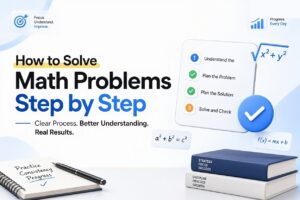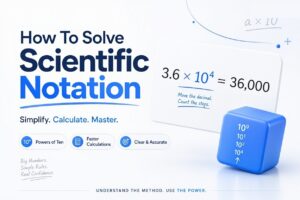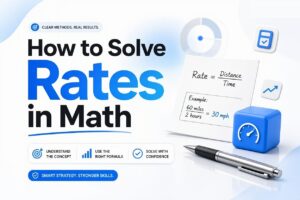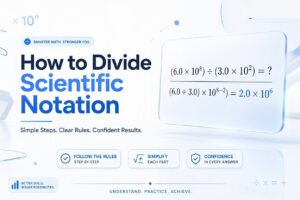
Primary school maths becomes far more manageable when children follow a reliable process: read carefully, identify the task, choose the right operation, show each step, and check the answer. This approach works for addition, subtraction, multiplication, division, fractions, measurement, word problems, and early geometry. It also reduces rushed mistakes.
Many pupils struggle not because they cannot calculate, but because they misread a word problem, skip a step, or use an operation that does not match the information provided. A calm routine turns larger questions into smaller, workable parts. Parents and teachers can reinforce the same routine at home and in class.
The aim is not to memorise random tricks. Children need to recognise number relationships, place value, mathematical language, and patterns. Regular practice matters, yet quality matters more than long worksheets. A few carefully checked problems often build stronger habits than dozens completed too quickly.
This guide gives practical methods for handling common primary-level questions. It also covers useful tools, comparisons between strategies, frequent mistakes, and ways to troubleshoot when an answer does not look right. Children can then approach new questions with more confidence and better accuracy.
Read the Question With Care
Before doing any calculation, read the entire question once without writing an answer. On a second reading, underline important numbers, units, and instruction words. Look for exactly what the question asks, since finding a number is not always the same as giving the required final answer.
Words such as total, altogether, more, fewer, difference, shared, each, left, and equal groups provide clues. However, these words should not be treated as automatic operation signals. The surrounding situation determines whether addition, subtraction, multiplication, or division is appropriate.
Teach children to restate the problem in their own words. For example, “There are 28 apples and 13 are eaten” can become “Start with 28, take away 13, then say how many remain.” Restating removes confusion and creates a clear plan before calculation begins.
Identify the Mathematical Operation
Addition combines amounts, while subtraction finds what remains or compares two amounts. Multiplication handles equal groups or repeated addition. Division shares a total into equal groups or finds how many groups can be made from a total.
A useful first check is whether the answer should become larger or smaller. Adding and multiplying positive whole numbers usually produce larger results. Subtracting and dividing usually produce smaller results. This estimate can expose an incorrect operation before the child spends time calculating.
Some problems need more than one operation. A shopping question may require multiplication to find the cost of several identical items, followed by subtraction to calculate change. Children should write one operation at a time rather than trying to hold every step mentally.
Useful Operation Clues
- Addition often combines groups, totals scores, or finds a final amount.
- Subtraction often finds a remainder, a difference, or an amount left.
- Multiplication often involves equal groups, rows, packs, or repeated amounts.
- Division often shares fairly, arranges equal groups, or finds how many fit.
- Mixed problems require children to complete one result before moving forward.
Use Place Value Before Calculating
Place value is the foundation of accurate primary maths. Every digit has a value based on its position. In 426, the 4 represents four hundreds, the 2 represents two tens, and the 6 represents six ones. Misreading position causes many avoidable errors.
When adding or subtracting written numbers, line up digits by place value. Ones must sit below ones, tens below tens, and hundreds below hundreds. A messy layout can produce a wrong answer even when the child knows the correct calculation method.
Partitioning is especially helpful for mental work. Instead of calculating 47 plus 36 in one jump, split it into 40 plus 30 and 7 plus 6. The answer becomes 70 plus 13, which equals 83. This makes number relationships visible.
Choose a Suitable Calculation Method
Children should know more than one method because different questions suit different approaches. Mental maths is effective for friendly numbers, while column methods help with larger values. Number lines support early subtraction, and arrays can show multiplication clearly.
For 398 plus 205, compensation may be quicker than a column method. Add 400 and 205 to make 605, then subtract 2 to get 603. For 786 plus 459, a written method may be more reliable because several place-value exchanges are needed.
The best method is the one the child can explain and check. Speed is helpful, but accuracy and clear reasoning are more important. Encourage pupils to write enough working that another person can see how the answer was reached.
Method Comparison for Common Calculations
| Problem Type | Helpful Method | Best Use |
| — | — | — |
| 34 + 25 | Partitioning | Mental calculation with two-digit numbers |
| 503 – 198 | Compensation | Numbers close to a round hundred |
| 246 + 378 | Column addition | Larger values with regrouping |
| 72 ÷ 4 | Grouping or facts | Division linked to multiplication knowledge |
| 6 × 8 | Array or times-table recall | Building multiplication confidence |
Solve Addition and Subtraction Problems
Addition should begin with a check that the amounts are being combined. Children can estimate first by rounding numbers. For 268 plus 157, rounding gives about 300 plus 200, or 500. The exact answer should therefore be near 500, not 325 or 825.
Column addition requires careful regrouping. Add the ones first, write the ones digit, and exchange ten ones for one ten when needed. Repeat this process in the tens and hundreds columns. Small carrying numbers should be written clearly above the next column.
Subtraction often causes difficulty when the top digit is smaller than the bottom digit. For 402 minus 187, regrouping is required across a zero. Children should use place-value language: exchange one hundred for ten tens, then exchange one ten for ten ones.
A number line offers another way to check subtraction. To calculate 83 minus 47, count upward from 47 to 83. Move from 47 to 50, then to 80, then to 83. Add the jumps: 3 plus 30 plus 3 equals 36.
Build Multiplication and Division Skills
Multiplication facts support many areas of primary maths, including fractions, measurement, area, and division. Rather than reciting tables without context, children should connect facts. If 6 times 4 equals 24, then 4 times 6 also equals 24, and 24 divided by 6 equals 4.
Arrays are useful visual models. Six rows of four counters show that six groups of four make 24. The same array can be turned sideways to show four groups of six. This reinforces commutativity, although division does not work in the same reversible way.
For long multiplication, begin by estimating. When calculating 34 times 6, the answer should be near 30 times 6, or 180. Then multiply 6 by 4 and 6 by 30 separately. Add 24 and 180 to reach 204.
Division needs children to identify whether they are sharing or grouping. Sharing asks how many each group receives. Grouping asks how many groups can be made. Both use the same division fact, but the language and interpretation can be different.
Practical Multiplication and Division Steps
1. Identify equal groups, repeated amounts, or fair sharing.
2. Draw counters, circles, an array, or a bar model when the situation is unclear.
3. Use a related multiplication fact if one is known.
4. Calculate one place-value part at a time for larger numbers.
5. Check division by multiplying the quotient by the divisor.
6. State any remainder clearly when the problem does not divide exactly.
Handle Word Problems With a Plan
Word problems combine reading skills with maths skills. Children should not rush from seeing numbers to performing an operation. First, identify the story, the known facts, and the missing quantity. Then decide which information is useful and which details are only background.
Bar models work well because they show relationships between quantities. For example, if Mia has 18 stickers and Leo has 7 more, draw one bar of 18 and a second bar of 18 plus 7. The diagram makes it clear that addition is needed.
Encourage children to write a number sentence before calculating. A number sentence for the sticker problem is 18 plus 7 equals 25. This creates a bridge between the words and the arithmetic, helping teachers and parents spot where an error began.
The final statement should answer the question in context. If the answer is 25, write “Leo has 25 stickers.” Units matter in measurement, money, time, and capacity questions. A bare number may be incomplete even when the calculation is correct.
Work With Fractions and Decimals
Fractions are easier when children see them as equal parts of one whole. A half means one of two equal parts, while one quarter means one of four equal parts. Unequal pieces do not represent correct fractional parts, even if the total shape looks divided.
Use visual models before relying only on symbols. Fold paper, shade shapes, or divide a strip into equal sections. This shows why two quarters equal one half and why four eighths also equal one half. Equivalent fractions become easier to recognise.
When comparing fractions with the same denominator, compare the numerators. Five eighths is greater than three eighths because five equal pieces are greater than three equal pieces. When denominators differ, use diagrams or equivalent fractions before introducing more formal methods.
Decimals connect closely to place value and money. In 3.45, the 4 represents four tenths and the 5 represents five hundredths. Lining up decimal points is essential when adding or subtracting decimal numbers, just as digits must align in whole-number calculations.
Fraction and Decimal Examples
| Task | Working | Answer |
| — | — | — |
| Find half of 18 | 18 ÷ 2 | 9 |
| Find one quarter of 20 | 20 ÷ 4 | 5 |
| Add 0.6 and 0.25 | 0.60 + 0.25 | 0.85 |
| Compare 3/4 and 2/3 | Use equivalent or visual models | 3/4 is larger |
| Find 3/5 of 25 | 25 ÷ 5, then × 3 | 15 |
Use Measurement, Time, and Money Accurately
Measurement questions require close attention to units. A child may calculate correctly but use centimetres instead of metres, or grams instead of kilograms. Before starting, identify the unit shown in the question and decide whether conversion is needed.
For example, 1 metre equals 100 centimetres, and 1 kilogram equals 1,000 grams. Children should not add or subtract quantities in different units until they have converted them to the same unit. This is similar to lining up place values before written arithmetic.
Time problems need careful counting across hours and minutes. A timetable question may ask for elapsed time rather than the clock time shown. Use a timeline to jump from the start time to the next hour and then to the end time.
Money questions should include decimal notation and currency symbols where appropriate. When calculating change, estimate first. If an item costs £3.75 and the customer pays £5, the change should be a little more than £1, which helps check the final result.
Check Answers Using More Than One Method
Checking should be part of every maths routine, not an optional extra for difficult questions. Start with estimation. If 49 times 8 produces an answer of 92, the result cannot be right because 50 times 8 is about 400.
Inverse operations are powerful checking tools. Addition can be checked with subtraction, and multiplication can be checked with division. If 37 plus 28 equals 65, check that 65 minus 28 equals 37. This confirms the relationship from a different direction.
Children can also repeat a calculation using another method. A number line may confirm a subtraction completed with a column method. Partitioning may confirm a multiplication result reached by formal written working. Different methods often reveal a missed regrouping or copied digit.
Checking the reasonableness of units is equally important. A child who writes that a pencil is 15 metres long should notice the result does not fit real life. Estimation, context, and units together provide a strong final review.
A Reliable Final Check
- Read the original question again.
- Confirm that every relevant number was used correctly.
- Check whether the operation matches the situation.
- Estimate whether the answer is a sensible size.
- Use an inverse operation or another method.
- Include the correct unit and a final sentence where needed.
Troubleshoot Common Maths Mistakes
When a child repeatedly makes errors, avoid immediately giving the answer. Look for the exact stage where the process went wrong. Was the question misread, was the operation incorrect, were digits misaligned, or did a fact recall error occur during the calculation?
A common addition mistake is forgetting to regroup. A common subtraction mistake is subtracting the smaller digit from the larger digit regardless of position. In multiplication, pupils may forget to multiply every place-value part. In division, they may confuse the divisor and quotient.
If a child freezes on word problems, reduce the amount of information visible at once. Cover unnecessary text, underline key facts, draw a model, and ask them to explain the situation aloud. Speaking through the task can reveal whether the barrier is reading or calculation.
Avoid overcorrecting every small error while a child is working. Let them finish, then ask checking questions such as “Does this answer seem too large or too small?” This develops independence and helps pupils spot patterns in their own mistakes.
Know the Limits of Shortcuts
Shortcuts can save time, but they should only be used after the underlying method is secure. Relying on a trick without place-value knowledge can fail when the numbers or context change. Children need flexible reasoning, not a collection of isolated rules.
Mental methods are not always the best choice. A child may accurately calculate 99 plus 26 mentally, but attempting 786 minus 459 without recording steps may lead to avoidable mistakes. Written working protects accuracy when several exchanges or facts are involved.
Calculator use also has limits in primary maths practice. Calculators can check answers or handle lengthy real-life figures, but they do not show whether a child selected the right operation. They should support reasoning, not replace it.
Some questions have more than one valid strategy. A pupil should not be told that one method is always wrong merely because it differs from a taught example. If the working is accurate, clear, and appropriate, different routes can lead to the same answer.
Conclusion
Learning how to solve primary school math problems depends on building a steady routine rather than searching for a fast trick. Read closely, identify the mathematical relationship, choose a suitable method, record the working, and check whether the final answer fits the situation. These habits apply across number, fractions, time, money, measurement, and problem-solving tasks.
Children make the most progress when they can explain what each step means. Visual models, number lines, arrays, bar models, and place-value charts are valuable because they make calculations easier to follow. As confidence grows, pupils can move gradually from concrete materials to mental and written methods.
Mistakes should be treated as useful evidence. They show whether a child needs more practice with facts, layout, vocabulary, regrouping, or interpreting word problems. With regular short practice, careful checking, and supportive feedback, primary maths becomes a skill children can use reliably in school and everyday life.
Frequently Asked Questions
How Children Can Improve Maths Accuracy?
Children improve accuracy by slowing down, lining up digits correctly, writing each step, and checking answers with estimation or inverse operations. Short, frequent practice sessions are usually more effective than rushed worksheets completed for long periods.
How Parents Can Help With Homework?
Parents can ask children to explain their method rather than supplying answers. Use everyday examples involving shopping, cooking, clocks, and games. Encourage clear working, praise persistence, and focus on one mistake at a time during corrections.
How Word Problems Become Easier?
Word problems become easier when children underline key facts, restate the situation, draw a bar model or picture, and write a number sentence. This separates the reading task from the calculation and reduces confusion.
How Times Tables Support Other Maths Topics?
Times tables support division, fractions, area, scaling, and mental calculation. Children should practise related fact families, such as 7 times 8, 8 times 7, 56 divided by 7, and 56 divided by 8.
How to Respond When an Answer Is Wrong?
Ask the child to estimate the expected answer, reread the question, and check each line of working. Find the first incorrect step instead of only correcting the final result, then practise one similar example.