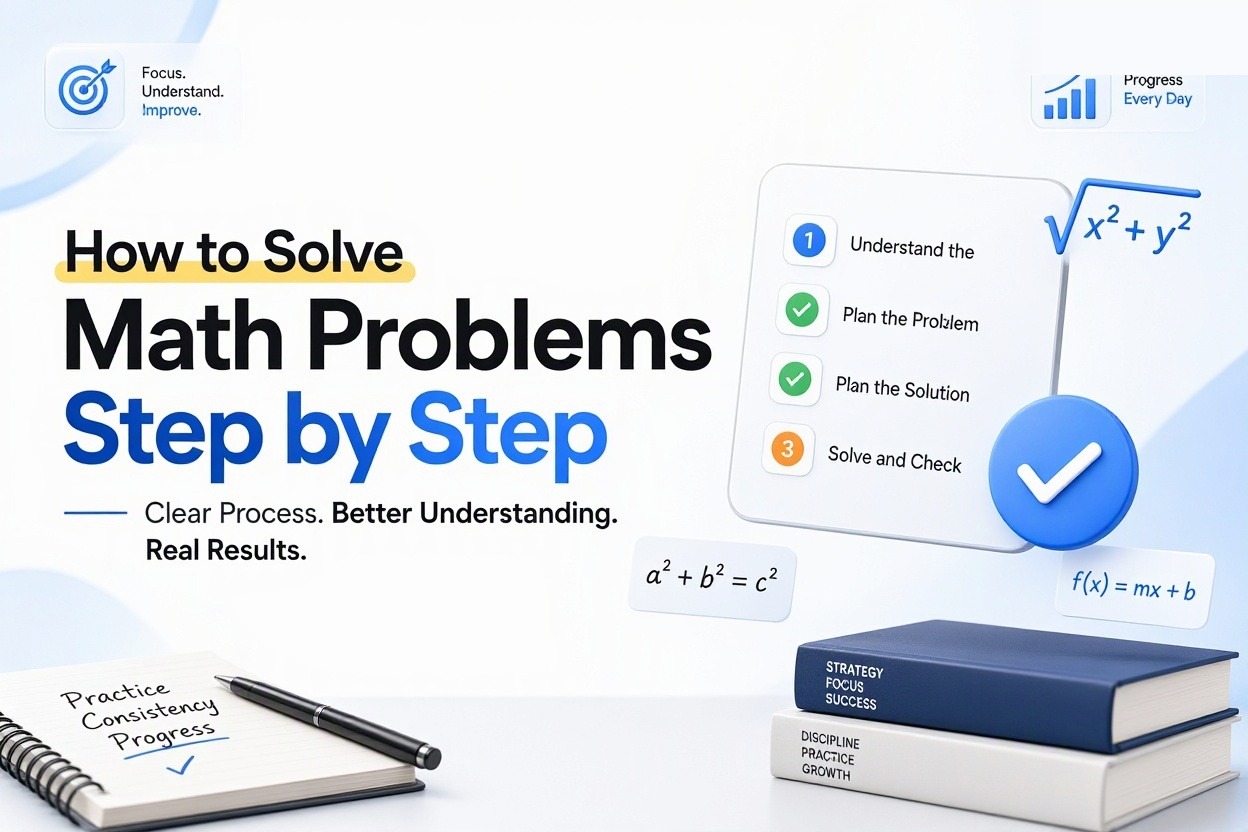
Math problems become far more manageable when you use a repeatable process instead of trying to spot the answer immediately. Start by reading carefully, identify what the problem gives you, choose a method that fits, work through each operation, and check whether the result makes sense. This approach works for arithmetic, algebra, geometry, percentages, word problems, and many higher-level topics.
Many mistakes happen before any calculation begins. A missed negative sign, an incorrect unit, or a rushed interpretation can send an otherwise correct method in the wrong direction. Slowing down at the start often saves time later, especially when a question contains several numbers, conditions, or formulas.
The goal is not to memorize every possible solution. It is to build habits that help you organize information, select useful tools, and verify your work. With a structured routine, difficult questions become a sequence of smaller decisions instead of one intimidating task.
This guide explains how to solve math problems step by step with practical methods you can use in class, homework, exams, and everyday calculations. It also covers common obstacles, checking strategies, and ways to improve when your first attempt does not work.
Read the Problem Carefully
Read the entire question before writing numbers or equations. Look for the action the problem requires, such as add, compare, find, prove, simplify, estimate, or calculate. Pay attention to qualifying words including total, difference, per, at least, remaining, and approximately, because each one changes the required method.
Then read the problem a second time and separate facts from instructions. Facts provide known values, conditions, diagrams, or relationships. Instructions tell you what result to find. If the wording feels dense, rewrite it in shorter language without changing its meaning or leaving out restrictions.
Identify the Unknown
Every math problem has a target, even if it is not stated as a variable. Ask yourself what exact value, expression, measurement, or conclusion the question expects. Write the unknown clearly, using a letter when appropriate. For example, write “Let x equal the number of tickets sold.”
Naming the unknown prevents unfocused calculations. It also helps when you build equations from word problems, because every relationship can be written around the same quantity. In geometry, the unknown may be an angle or length. In statistics, it may be a mean, probability, or rate.
Key Details to Mark
1. Circle or underline the value you need to find.
2. List every given number with its unit.
3. Mark relationship words such as more than, twice, equal to, and percent of.
4. Note restrictions, including positive values, whole numbers, or rounded answers.
5. Record formulas supplied in the question before beginning calculations.
Choose the Right Math Method
Once you know the target and the known information, decide which operation or formula connects them. Addition combines quantities, subtraction compares or finds what remains, multiplication scales equal groups, and division shares or finds a rate. Algebraic problems often require rearranging an equation or solving for a variable.
Do not choose a method based only on the largest number in the problem. Focus on the relationship between values. If a price increases by 15 percent, multiplication by 1.15 is appropriate. If two lengths form a right triangle, the Pythagorean theorem may apply rather than ordinary addition.
Write a Plan Before Calculating
A short plan reduces careless work and makes corrections easier. Write the formula, equation, or sequence of operations you intend to use. For a multi-step word problem, state what each stage will find. This creates a record you can review if your final answer seems incorrect.
For example, to calculate a discount followed by sales tax, first find the discounted price, then calculate tax on that new amount, and finally add it. Applying tax to the original price would create a different result and would not match the stated order.
Common Problem Types and Methods
| Problem type | Useful method | Typical check |
| — | — | — |
| Fractions | Find common denominators | Answer is in lowest terms |
| Linear equations | Isolate the variable | Substitute back into equation |
| Percentages | Convert percent to decimal | Compare with estimate |
| Geometry | Use the relevant formula | Confirm units are squared or cubed |
| Ratios | Build equivalent ratios | Check proportional relationship |
| Word problems | Define a variable and equation | Confirm answer fits the story |
Translate Words Into Math
Word problems become clearer when you translate phrases into symbols and equations. “More than” usually indicates addition, while “less than” often indicates subtraction. “Of” frequently means multiplication, particularly in percentage questions. “Per” commonly signals division, such as miles per hour or cost per item.
Word order matters. “Five less than a number” means x − 5, while “five minus a number” means 5 − x. These expressions are not interchangeable. Carefully identifying the subject of each phrase prevents one of the most frequent algebra mistakes.
Organize Information Visually
A diagram, table, number line, or labeled sketch can reveal relationships that are difficult to hold mentally. Draw a rectangle for area questions, a timeline for elapsed-time problems, or a bar model for comparison questions. The drawing does not need artistic quality; it only needs accurate labels.
For data-heavy questions, make a small table with columns for quantity, rate, time, cost, or unit. Organizing information visually is especially useful when several values must be matched correctly. It also helps expose missing information before you begin an unnecessary calculation.
A Short Word Problem Example
A taxi charges a base fare of $4 plus $2.50 per mile. A passenger travels 6 miles.
Let x represent the total cost. Write the relationship as x = 4 + 2.50(6). Multiply first: 2.50 × 6 = 15. Add the base fare: x = 19. The trip costs $19.
The final check is practical. A six-mile ride should cost more than the $4 starting charge, and $19 is consistent with six groups of $2.50 plus that fee. This reasonableness check supports the arithmetic.
Follow the Order of Operations
When an expression contains several operations, use the standard order of operations. Work through grouping symbols first, then exponents, multiplication and division from left to right, and finally addition and subtraction from left to right. Skipping this order can produce a completely different answer.
For example, in 8 + 3 × 4, multiply 3 × 4 first to get 12, then add 8 for a result of 20. Adding 8 and 3 first would incorrectly produce 44. Parentheses should be treated as clear instructions to calculate part of an expression first.
Show Each Step Clearly
Write one main operation per line whenever possible. This makes your reasoning easier to inspect and lowers the risk of losing a sign, decimal, or exponent. Avoid trying to perform multiple transformations mentally when the problem contains fractions, variables, or several terms.
In equations, apply the same operation to both sides and write the result on the next line. For example, if 3x + 7 = 22, subtract 7 from both sides before dividing by 3. Clear formatting is not just presentation; it is a practical error-control method.
Order of Operations Example
Evaluate 18 ÷ 3 + 2(5 − 1).
First calculate inside parentheses: 5 − 1 = 4.
Then multiply and divide from left to right: 18 ÷ 3 = 6 and 2 × 4 = 8.
Finally add the results: 6 + 8 = 14.
Use Estimation to Catch Errors
Estimate before or after calculating, especially with decimals, percentages, and large numbers. An estimate does not replace exact work, but it gives you a realistic range. If your calculator returns 4,500 when you expected something near 45, you know to recheck entries and decimal placement.
Round values in a way that keeps the estimate useful. For 19.8 × 4.1, think of 20 × 4, which is about 80. If the exact result is near 81, it is plausible. If you get 8.118, a decimal has likely been placed incorrectly.
Check Units and Labels
Units are part of the answer, not an optional detail. A speed answer should include distance per time, an area answer should include square units, and a volume answer should include cubic units. In applied problems, an answer without units may be incomplete even when the number is correct.
Use units as a checking tool throughout the calculation. If you divide dollars by hours, the result should be dollars per hour. If the units do not match the question’s request, review whether you multiplied or divided incorrectly or used an irrelevant value.
Use Inverse Operations for Verification
Inverse operations help you check many answers quickly. Addition is checked with subtraction, multiplication with division, squaring with square roots, and exponentiation with logarithms when appropriate. For equations, substitute the value you found back into the original statement to see whether both sides match.
Suppose you solve 4x − 9 = 19 and get x = 7. Substitute 7: 4(7) − 9 = 28 − 9 = 19. The original equation is true, so the value passes the check. This verification takes little time and catches many calculation errors.
Checking Methods by Problem Type
| Type of work | Best verification method |
| — | — |
| Arithmetic | Estimate and reverse operation |
| Equation solving | Substitute into original equation |
| Fraction work | Convert to decimals or simplify again |
| Geometry | Check formula, diagram, and units |
| Percent change | Compare result with original amount |
| Graphing | Test a plotted point in the equation |
Handle Fractions, Decimals, and Percentages Carefully
Fractions, decimals, and percentages represent related forms of the same value, but they require different handling. Convert between them when it makes the calculation easier. For instance, 25 percent is 0.25 or one-fourth, making it easy to calculate a quarter of a quantity.
When adding or subtracting fractions, use a common denominator before combining numerators. When multiplying fractions, multiply numerators and denominators directly, then simplify. When dividing fractions, multiply by the reciprocal of the second fraction. Write these transitions clearly to avoid reversing the wrong number.
Avoid Early Rounding
Keep extra decimal places during intermediate calculations unless the question gives specific rounding instructions. Rounding too soon can create noticeable inaccuracies, particularly in measurements, interest calculations, and repeated operations. Round only at the final stage, then state the result to the requested precision.
For example, if a calculation gives 12.4967 and the answer needs two decimal places, report 12.50. Look at the third decimal place to decide whether the second decimal rounds upward. Include a leading zero for decimals smaller than one, such as 0.45.
Work Through Algebra Systematically
Algebra problems become more reliable when you treat an equation like a balance. Whatever operation you perform on one side must be performed on the other. Your aim is usually to isolate the variable while preserving equality at every stage.
Combine like terms before moving terms across an equals sign. Like terms have the same variable part and exponent, such as 3x and −5x. Terms like 4x and 4x² are not like terms, so they cannot be combined through addition or subtraction.
Know When a Formula Is Needed
Many geometry, physics, finance, and statistics questions require formulas. Before substituting values, write the formula in its original form and identify every variable. Then replace each variable with the given value, including units, and calculate in the stated order.
A formula is only useful when it matches the conditions of the problem. The area formula for a rectangle does not apply directly to a triangle, and an average does not necessarily represent every data point. Check the shape, quantity, or relationship before selecting a formula.
Algebra Troubleshooting Checklist
1. Check whether you copied every sign and exponent correctly.
2. Confirm that terms were combined only when they were alike.
3. Review each operation performed on both sides of an equation.
4. Check for distribution errors when parentheses are present.
5. Substitute the final variable value into the original equation.
Use Tools Without Losing Control
Calculators, graphing software, and online practice tools can speed up arithmetic and visualize functions. They are useful after you have selected a method and entered the expression carefully. A tool can evaluate an incorrect setup perfectly, so it cannot replace reading, planning, or checking.
When using a calculator, enter long expressions with parentheses to preserve the intended order. Review the display before pressing equals. For graphs, test a few points manually and confirm the scale. If technology gives an unexpected result, compare it with an estimate before accepting it.
Recognize Limits and Ambiguous Problems
Not every problem has one neat numerical answer. Some equations have no solution, infinitely many solutions, or multiple valid answers. Real-world questions can also require assumptions about rounding, measurement precision, taxes, or missing data. State those assumptions when they affect the result.
If a problem seems impossible, reread it for hidden conditions or missing information. Check whether a diagram is drawn to scale, whether units need conversion, or whether the question asks for an exact form rather than a decimal. Identifying ambiguity is part of accurate mathematical work.
Build Better Problem-Solving Habits
Practice improves results when you review mistakes instead of only checking whether an answer was right or wrong. Keep a short error log noting the type of mistake: misread wording, wrong formula, arithmetic slip, skipped unit, or incomplete simplification. Patterns will show you what needs attention.
Mix easy and challenging exercises rather than repeating only familiar examples. Explain your solution aloud or in writing as if teaching another person. If you cannot justify a step, return to that point and identify the rule or relationship behind it. This builds dependable habits over time.
Conclusion
Learning how to solve math problems step by step is less about fast calculation and more about using a dependable sequence. Read the problem carefully, identify the target, organize the known information, choose a method, show the work, and verify the result. These actions reduce avoidable errors and make complex questions easier to manage.
Good mathematical work also includes sensible checks. Estimate the expected range, confirm units, substitute answers back into equations, and consider whether the result fits the situation. When an answer fails a check, do not start randomly from the beginning. Locate the first questionable step and test it carefully.
With regular practice, this process becomes more natural. You will spend less time guessing which operation to use and more time making deliberate choices. That confidence carries across school assignments, professional tasks, budgeting, measurements, and any situation where accurate reasoning matters.
Frequently Asked Questions
What is the first step in solving a math problem?
Read the entire problem and identify exactly what it asks you to find. Then list the known values, units, and conditions. This prevents you from choosing an operation before you know what relationship the question describes.
How can I check whether my math answer is correct?
Use an inverse operation, substitute your answer into the original equation, or estimate a reasonable range. Also check units and signs. If the result is unrealistic for the situation, review the setup before assuming arithmetic caused the error.
Why do I make mistakes in word problems?
Word problems often combine reading comprehension with calculation. Errors commonly come from missing relationship words, reversing subtraction, or using irrelevant numbers. Rewrite the problem in shorter statements, define the unknown, and translate each relationship into an equation.
Should I use a calculator for every math problem?
Use a calculator when arithmetic is lengthy or when the task permits it, but first decide which operation or formula is appropriate. Estimate the result before calculating, because a calculator cannot identify an incorrectly entered expression or unsuitable method.
What should I do when I get stuck on a difficult problem?
Pause and identify the last step you know is correct. Draw a diagram, list the facts, try a smaller example, or check related formulas. If needed, move on temporarily and return with a clearer perspective.