
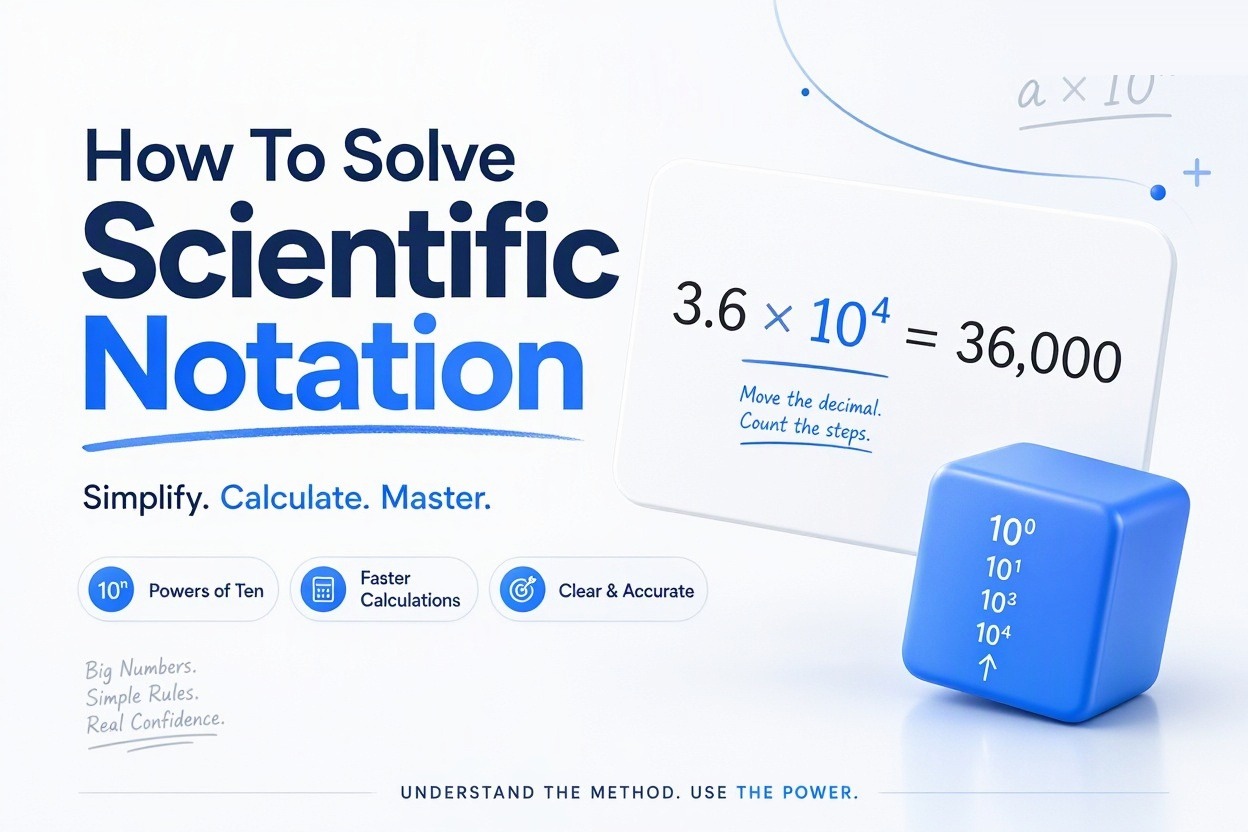
Scientific notation makes extremely large or tiny values easier to read, calculate, and compare. To solve scientific notation problems, identify the coefficient, track the exponent, and move the decimal point in the correct direction. Positive exponents shift the decimal right, while negative exponents shift it left.
You will also need different rules for multiplication, division, addition, subtraction, and powers. The process becomes reliable when you keep coefficients and powers of ten separate until the final step. This prevents misplaced decimals, sign errors, and incorrectly normalized answers.
For example, 4.2 × 10³ means 4.2 multiplied by 1,000, which equals 4,200. Meanwhile, 4.2 × 10⁻³ equals 0.0042. The exponent tells you how many positions to move, and its sign tells you the direction. Once this foundation is clear, scientific notation becomes a practical shortcut rather than a confusing math format.
What Scientific Notation Means
Scientific notation writes a number as a coefficient multiplied by a power of ten. A standard expression looks like a × 10ⁿ, where the coefficient is at least one but less than ten, and n is any whole-number exponent.
The coefficient contains the important digits of the original number. The exponent shows the decimal movement required to return to regular notation. This format is widely used in chemistry, astronomy, engineering, physics, finance, and calculator-based calculations.
For instance, 6,300,000 can be written as 6.3 × 10⁶. The decimal moved six places left to create 6.3, so the exponent is positive six. The notation preserves the value while making it more compact.
Converting Positive Exponents to Standard Form
A positive exponent means the original number is greater than or equal to ten. Start at the decimal point in the coefficient and move it right by the number of positions shown in the exponent.
For 7.15 × 10⁴, move the decimal four places right. The result becomes 71,500. Add zeros if there are not enough digits available to complete every movement.
A positive exponent does not mean you add zeros automatically. You only add zeros when the decimal passes beyond the existing digits. Tracking each move carefully produces more accurate results than relying on visual guesses.
Quick Conversion Examples
1. 3.8 × 10² = 380
2. 9.04 × 10³ = 9,040
3. 1.2 × 10⁵ = 120,000
4. 6.75 × 10¹ = 67.5
5. 4 × 10⁶ = 4,000,000
Converting Negative Exponents to Standard Form
A negative exponent represents a number smaller than one. Move the decimal point left by the number of places shown after the negative sign. Add zeros between the decimal point and the first digit as needed.
For 5.6 × 10⁻⁴, move the decimal four positions left. The result is 0.00056. The first movement places the decimal before the 5, and the remaining movements create zeros.
Negative exponents are common when measuring very small quantities, such as cell sizes, wavelengths, atomic distances, and electrical charges. Write a leading zero before the decimal point to make the final answer easier to read.
Converting Standard Form to Scientific Notation
To convert a large regular number, move its decimal left until only one nonzero digit remains before the decimal point. Count the number of moves, then use that count as a positive exponent.
For 845,000, the decimal moves five places left to make 8.45. The scientific notation form is 8.45 × 10⁵. The coefficient remains between one and ten, which confirms standard scientific notation.
For a number less than one, move the decimal right until the coefficient is between one and ten. The number of moves becomes a negative exponent because the original decimal location was farther left.
Decimal Movement Reference Table
| Original Value | Scientific Notation | Decimal Direction | Exponent |
| — | — | — | — |
| 52,000 | 5.2 × 10⁴ | Left | Positive |
| 0.0071 | 7.1 × 10⁻³ | Right | Negative |
| 9,400,000 | 9.4 × 10⁶ | Left | Positive |
| 0.000083 | 8.3 × 10⁻⁵ | Right | Negative |
Multiplying Numbers in Scientific Notation
When multiplying scientific notation values, multiply the coefficients first. Then add the exponents because powers with the same base follow the rule 10ᵃ × 10ᵇ = 10ᵃ⁺ᵇ.
For example, multiply 2 × 10³ by 4 × 10⁵. Multiply 2 by 4 to get 8, then add three and five to get eight. The answer is 8 × 10⁸.
If the coefficient in your answer is ten or greater, normalize it. For example, 24 × 10⁶ becomes 2.4 × 10⁷ because moving the decimal left one place increases the exponent by one.
Dividing Numbers in Scientific Notation
For division, divide the coefficients and subtract the exponents. This follows the exponent rule 10ᵃ ÷ 10ᵇ = 10ᵃ⁻ᵇ. Keep the coefficient calculation and exponent calculation separate until the end.
For example, divide 8 × 10⁷ by 2 × 10³. Divide eight by two to get four, then subtract three from seven to get four. The final answer is 4 × 10⁴.
A negative result after subtracting exponents is valid. Dividing 6 × 10² by 3 × 10⁵ gives 2 × 10⁻³, which equals 0.002 in standard notation.
Multiplication and Division Steps
1. Multiply or divide the coefficients.
2. Add exponents for multiplication.
3. Subtract exponents for division.
4. Rewrite the coefficient if it falls outside the range from one to ten.
5. Check whether the final exponent matches the approximate size of the answer.
Adding Scientific Notation Correctly
Addition requires a different method because exponents must match before coefficients can be combined. You cannot directly add 3 × 10⁴ and 2 × 10³ without first rewriting one expression.
Rewrite 2 × 10³ as 0.2 × 10⁴. Now both terms use 10⁴, so add the coefficients: 3 + 0.2 = 3.2. The result is 3.2 × 10⁴.
Choose the larger exponent as the shared exponent in most cases. This keeps the coefficient manageable and reduces the chance of writing a coefficient that is too large or too small.
Subtracting Scientific Notation Accurately
Subtraction follows the same matching-exponent rule. Rewrite one number so both expressions use the same power of ten, then subtract the coefficients while keeping the shared exponent unchanged.
For example, subtract 4.6 × 10⁶ from 7.2 × 10⁶. The exponents already match, so subtract 4.6 from 7.2. The answer is 2.6 × 10⁶.
If the exponents differ, adjust one term first. To solve 5 × 10⁵ minus 8 × 10⁴, rewrite 8 × 10⁴ as 0.8 × 10⁵. Then subtract to get 4.2 × 10⁵.
Addition and Subtraction Practice
| Problem | Rewrite Needed | Answer |
| — | — | — |
| 3 × 10⁴ + 5 × 10⁴ | No | 8 × 10⁴ |
| 6 × 10⁵ + 2 × 10⁴ | 2 × 10⁴ = 0.2 × 10⁵ | 6.2 × 10⁵ |
| 9 × 10³ − 4 × 10² | 4 × 10² = 0.4 × 10³ | 8.6 × 10³ |
| 7.1 × 10⁻² − 2 × 10⁻² | No | 5.1 × 10⁻² |
Solving Powers and Roots
When raising scientific notation to a power, apply the power to both parts of the expression. For example, (3 × 10²)² becomes 3² × (10²)², which equals 9 × 10⁴.
For cube powers, multiply the exponent by three. For instance, (2 × 10³)³ equals 8 × 10⁹. The coefficient may need normalization if its powered value reaches ten or more.
Square roots work in reverse when both the coefficient and exponent allow clean roots. The square root of 9 × 10⁶ equals 3 × 10³ because the square root of nine is three and half of six is three.
Using a Calculator for Scientific Notation
Most scientific calculators use an EE or EXP key to enter powers of ten. Enter the coefficient, press EE or EXP, and type the exponent. Avoid entering the multiplication sign and the number ten separately unless your calculator requires it.
For 6.2 × 10⁻⁷, type 6.2, press EE, then enter negative seven. The display may show 6.2E-7. The letter E represents “times ten to the power of” in calculator notation.
Check calculator displays carefully after operations. A result such as 1.25E8 means 1.25 × 10⁸, not 1.25 plus eight. Misreading the E format is a common source of otherwise avoidable mistakes.
Calculator Checking Tips
1. Estimate the answer before using the calculator.
2. Confirm that negative exponents include the negative sign.
3. Use parentheses around an entire scientific notation expression before applying powers.
4. Convert the final result to standard notation when your assignment requires it.
5. Round only at the final stage unless directions specify otherwise.
Common Scientific Notation Mistakes
A frequent error is moving the decimal in the wrong direction. Remember that converting from scientific notation uses the exponent sign directly: positive goes right, and negative goes left.
Another mistake occurs during addition and subtraction. Coefficients can only be combined after the exponents match. Adding coefficients with different powers of ten produces an answer with the wrong place value.
Students also forget to normalize coefficients. An expression such as 0.45 × 10⁸ has the correct value but is not standard scientific notation. Rewrite it as 4.5 × 10⁷ instead.
Troubleshooting Incorrect Answers
If your answer seems too large, check whether you used a positive exponent when a negative exponent was required. A sign reversal can change a tiny decimal into a massive number or the reverse.
If your multiplication answer has an unexpected exponent, revisit the exponent arithmetic. Addition applies only to multiplication, while subtraction applies only to division. Writing the exponent rule beside the problem can prevent confusion.
If the coefficient is outside the proper range, shift its decimal one place at a time and adjust the exponent in the opposite direction. Moving left increases the exponent; moving right decreases it.
Comparison of Core Rules
| Operation | Coefficients | Exponents |
| — | — | — |
| Convert to standard form | Keep coefficient digits | Move decimal by exponent |
| Multiply | Multiply | Add |
| Divide | Divide | Subtract |
| Add or subtract | Combine after matching powers | Make exponents equal |
| Raise to a power | Raise coefficient | Multiply exponent |
Practical Uses and Limits
Scientific notation is useful whenever scale makes regular numbers difficult to handle. Scientists use it for distances between planets, bacterial measurements, energy values, chemical concentrations, and population calculations involving extremely large quantities.
It also supports meaningful comparison. Comparing 3.5 × 10⁹ with 8.1 × 10⁷ is faster than comparing long strings of digits. The larger exponent indicates the larger overall magnitude when coefficients are positive.
However, scientific notation does not remove the need for correct units, rounding rules, or significant figures. A mathematically correct expression can still be incomplete if it omits meters, grams, seconds, dollars, or another required measurement unit.
Conclusion
Learning how to solve scientific notation depends on a small set of repeatable rules. Move decimals according to exponent signs when converting forms, add exponents for multiplication, subtract them for division, and match powers before adding or subtracting. Keep the coefficient and exponent work separate until the final answer.
Accuracy improves when you estimate the likely size of the result before calculating. A positive exponent should generally produce a large value, while a negative exponent should usually produce a small decimal. This quick check catches many decimal-placement mistakes before they affect the final solution.
Practice with mixed operations is especially valuable because each operation uses a different exponent rule. Write each stage clearly, normalize coefficients when necessary, and use calculator E notation carefully. With those habits, scientific notation becomes a dependable way to manage numbers that would otherwise be cumbersome, unclear, or easy to misread.
Frequently Asked Questions
Why Is the Coefficient Between One and Ten?
Standard scientific notation uses a coefficient from one up to, but not including, ten. This convention gives each value one consistent form and makes comparisons, calculations, and significant figures easier to manage.
How Do Negative Exponents Work?
Negative exponents indicate values less than one. Move the decimal left when converting from scientific notation to standard form. For example, 2.5 × 10⁻³ becomes 0.0025 after three leftward moves.
Can I Add Different Exponents Directly?
No. Rewrite one term so both values have the same exponent before adding coefficients. For example, change 4 × 10³ into 0.4 × 10⁴ before adding it to a value expressed with 10⁴.
What Does E Mean on a Calculator?
The letter E represents a power of ten in calculator displays. For instance, 7.3E-5 means 7.3 × 10⁻⁵. It is not Euler’s number in this context.
When Should I Normalize an Answer?
Normalize whenever the coefficient is less than one or equal to ten or greater. Shift the decimal until the coefficient is at least one and below ten, then adjust the exponent to preserve value.